
TNPSC Books
-
 TNPSC General English Book - for Group 2 & 2A
Original price was: ₹1,000.00.₹850.00Current price is: ₹850.00.
-
TNPSC பொதுத் தமிழ் Book - for Group 2, 2A, 3, 4 & VAO
Original price was: ₹1,000.00.₹850.00Current price is: ₹850.00.
Group 1 Courses

Class Tests
PRIVATE 67
TNPSC Group 1 - Test Series - 2019
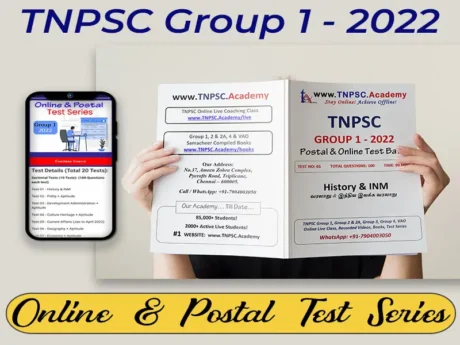
Original price was: ₹3,500.00.₹2,800.00Current price is: ₹2,800.00. 542Group 1 | Postal and Online Test Series | 2022
Original price was: ₹3,200.00.₹2,800.00Current price is: ₹2,800.00. 88


Group 2 & 2A Courses
TNPSC Group 2 and 2A MAINS - 2022
PRIVATE 344TNPSC Group 2 and 2A - Test Series - 2019 - தமிழ்
Original price was: ₹2,400.00.₹1,800.00Current price is: ₹1,800.00. 175TNPSC Group 2 and 2A - Test Series - 2019
Original price was: ₹2,400.00.₹1,800.00Current price is: ₹1,800.00. 527Class Tests
PRIVATE 67



www.tnpsc.academy – TNPSC Current Affairs Nov 28, 2019 (28/11/2019)
Download as PDF
Topic: New Inventions on Science and Health
Trachischium apteii
It is a newly discovered snake species from Arunachal Pradesh. It was found in Tally Valley Wildlife Sanctuary. It belongs to a group of fossorial (adapted to digging) snakes that live mostly underground, and surface mainly during or after a heavy monsoon shower.
_
Topic: Latest Diary of Events
HIM VIJAY Military Exercise
HIM Vijay is the Indian Army’s biggest mountain combat exercise. It is the first-ever military drill that was held in the north-eastern state of Arunachal Pradesh. The exercise will include troop mobilisation, mountain assault and air assault.
_
Topic: Recent Reports and Studies, Latest Diary of Events
Emission Gap Report
The annual United Nations Environment Programme (UNEP) flagship Emissions Gap Report has been released.
What is the “Emissions Gap”?
Also called as the “Commitment Gap”, it is the difference between the low level of emissions that the world needs to drop to, compared with the projected level of emissions based on countries’ current commitments to decarbonization.
It measures the gap between what we need to do and what we are actually doing to tackle climate change.
Why does the Emissions Gap Matter?
The gap is important because if we can’t close it and meet the emissions reduction target, we will face increasingly severe climate impacts worldwide.
Therefore, it is important that policymakers, and their citizens, know what the gap is so that the commitments countries are making are sufficient to close the gap.
Key findings of the report:
The world will fail to meet the 1.5°C temperature goal of the Paris Agreement unless global greenhouse gas emissions fall by 7.6 per cent each year.
Global temperatures are set to rise about 3.2 degrees C by 2100, the report says, bringing catastrophic weather including hotter, deadlier heatwaves and more frequent floods and drought.
The top four emitters (China, USA, EU and India) contributed to over 55% of the total emissions over the last decade, excluding emissions from land-use change such as deforestation.
The rankings would change if land-use change emissions were included, with Brazil likely to be the largest emitter.
Where India stands?
India is the fourth-largest emitter of Green House Gases (GHGs).
It is among a small group of countries that are on their way to achieve their self-declared climate targets under the Paris Agreement.
_
Topic: World Organizations, Latest Diary of Events
Contract for the Web
Sir Tim Berners-Lee, inventor of the World Wide Web, has announced a “Contract for the Web” — aimed at saving the future of his invention.
What is the Contract for the Web?
The idea is to create a global plan of action for all stakeholders to together commit to building a “better” Web. The goal is to create a standard policy for a Web that benefits all.
The Contract consists of nine principles — three each for governments, private companies, and individuals and civil society to endorse.
It has been created by representatives from over 80 organisations, including governments, companies, civil society activists, and academics.
What are the principles in the Contract?
Governments will “Ensure everyone can connect to the Internet”, “Keep all of the Internet available, all of the time”, and “Respect and protect people’s fundamental online privacy and data rights”.
Companies will “Make the Internet affordable and accessible to everyone”, “Respect and protect people’s privacy and personal data to build online trust”, and “Develop technologies that support the best in humanity and challenge the worst”.
Citizens will “Be creators and collaborators on the Web”, “Build strong communities that respect civil discourse and human dignity”, and “Fight for the Web” so that it “remains open and a global public resource for people everywhere, now and in the future”.