
TNPSC Books
-
 TNPSC பொதுத் தமிழ் Book - for Group 2, 2A, 3, 4 & VAO
Original price was: ₹1,000.00.₹850.00Current price is: ₹850.00.
-
TNPSC General English Book - for Group 2 & 2A
Original price was: ₹1,000.00.₹850.00Current price is: ₹850.00.
Group 1 Courses

TNPSC Group 1 - Test Series - 2019
Original price was: ₹3,500.00.₹2,800.00Current price is: ₹2,800.00. 542
Class Tests
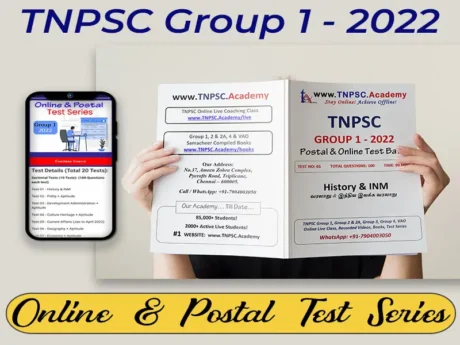
PRIVATE 67Group 1 | Postal and Online Test Series | 2022
Original price was: ₹3,200.00.₹2,800.00Current price is: ₹2,800.00. 88



Group 2 & 2A Courses
TNPSC Group 2 and 2A MAINS - 2022
PRIVATE 344TNPSC Group 2 and 2A - Test Series - 2019 - தமிழ்
Original price was: ₹2,400.00.₹1,800.00Current price is: ₹1,800.00. 175TNPSC Group 2 and 2A - Test Series - 2019
Original price was: ₹2,400.00.₹1,800.00Current price is: ₹1,800.00. 527Class Tests
PRIVATE 67





www.tnpsc.academy – TNPSC Current Affairs July 24, 2020 (24/07/2020)
Download as PDF
Topic: Profile of States
Public Electric Vehicle Charging Plaza
India’s first public EV (Electric Vehicle) charging plaza was inaugurated at New Delhi. The charging plaza has been set up with a focus on enhancing energy efficiency and promoting e-mobility. This plaza will host 5 EV chargers of different specifications.
_
Topic: Eminent Persons in News
Chandra Shekhar Azad
23rd July- Birth Anniversary.
What you need to know about Chandra Shekhar Azad?
Born on July 23, 1906, at Bhavra, Alirajpur District in present-day Madhya Pradesh. He took part in non-cooperation movement when he was 15.
After the suspension of the non-cooperation movement in 1922 by Gandhi, Azad joined Hindustan Republican Association (HRA). HRA was later reorganised as the Hindustan Socialist Republican Army (HSRA) in 1928.
Why he is called “Azad”?
He was arrested because of his participation in the non-cooperation movement. When produced by the magistrate, he proudly announced his name as ‘Azad’, his father’s name as ‘Swatantrata’ and his place of dwelling as ‘Jail’. It was from then on that the name ‘Azad’ stuck to him.
_
Topic: Eminent Persons in News
Bal Gangadhar Tilak
23rd July- Birth Anniversary.
His famous declaration “Swaraj is my birthright, and I shall have it” served as an inspiration for future revolutionaries during India’s struggle for freedom.
The British Government termed him as the “Father of Indian Unrest” and his followers bequeathed upon him the title of ‘Lokmanya’meaning he who is revered by the people.
Topic: General Administration
Government Order for PC of Women in Army
Recently, the Ministry of Defence has issued the formal Government Sanction Letter for grant of Permanent Commission (PC) to Women Officers in the Indian Army.
Key Facts:
The order specifies grant of PC to Short Service Commissioned (SSC) Women Officers in the remaining 8 streams of the Indian Army.
These 10 streams include Army Air Defence (AAD), Signals, Engineers, Army Aviation, Electronics and Mechanical Engineers (EME), Army Service Corps (ASC), Army Ordnance Corps (AOC), Intelligence Corps, Judge and Advocate General (JAG) and Army Educational Corps (AEC).
Before the order, women officers are allowed a PC in the JAG and AEC.
In anticipation, the Army Headquarters had set in motion a series of preparatory actions for the conduct of the Permanent Commission Selection Board (PCSB) for the eligible women officers.
The Selection Board will be scheduled as soon as all eligible SSC Women Officers exercise their option and complete requisite documentation.
Issue:
Under the SSC scheme, women were commissioned into the Army for a period of 10 years, extendable up to 14 years.
Women were, however, restricted to roles in specified streams such as Army Education Corps, Corps of Signals, Intelligence Corps and Corps of Engineers. These specified streams excluded combat arms such as infantry and armoured corps.
While male SSC officers could opt for permanent commission at the end of 10 years of service, this option was not available to women officers. Women officers were kept out of any command appointment and could not qualify for a government pension, which starts only after 20 years of service as an officer.
Background:
The case was first filed in the Delhi High Court by women officers in 2003 and had received a favourable order in 2010.
However, the order was never implemented and was challenged in the Supreme Court by the government.
In its appeal, the government cited “physical” and “physiological limitations” in granting command positions to women.
In the February 2019 policy statement, the Government endorsed the PC for SSC women officers in 10 streams of the ‘Combat Support Arms’ and ‘Services’ sections.
However, it was said that the women officers would not be offered any command appointments, and would serve only in staff posts.
In February 2020, the SC held that there is a need for an administrative will and ‘change of mindset’ and directed the government to grant PC and command postings in all services other than combat to women Army officers.
_
Topic: Political System in India
Plea Bargaining
Several citizens of various countries, who were accused of violating visa conditions and government guidelines following the Covid-19 pandemic, have obtained release from court cases in recent days by means of plea bargaining.
Key Facts:
Plea bargaining refers to a person charged with a criminal offence (accused) negotiating with the prosecution for a lesser punishment than what is provided in law by pleading guilty to a less serious offence.
It primarily involves pretrial negotiations between the accused and the prosecutor. It may involve bargaining on the charge or in the quantum of sentence.
Provision in India:
Plead Guilty: There has always been a provision in the Code of Criminal Procedure (CrPC) for an accused to plead ‘guilty’ instead of claiming the right to a full trial, but it is not the same as plea bargaining.
Plea Bargaining: Plea bargaining was introduced in 2006 as part of a set of amendments to the CrPC as Chapter XXI-A, containing Sections 265A to 265L.
Cases for which the plea bargaining is allowed are limited.
Procedure in India:
The plea bargaining process can be initiated only by the accused. This provision is different from the one in other countries like the USA where the prosecutor plays a key role in bargaining with the suspected offender.
The accused will have to apply to the court for invoking the benefit of bargaining.
Thereafter, the court may permit the prosecutor, the investigating officer and the victim (if any) to hold a meeting for a “satisfactory disposition of the case”.
Once mutual satisfaction is reached, the court formalises the arrangement by way of a report signed by all the parties and the presiding officer.
The accused may be sentenced to a prison term that is half the minimum period fixed for the offence.
If there is no minimum term prescribed, the sentence should run up to one-fourth of the maximum sentence stipulated in law.
The outcome may also involve payment of compensation and other expenses to the victim by the accused.
_
Topic: Current Socio-Economic Issues
Increase in Gold Prices
Recently, the gold prices crossed Rs. 50,000 per 10 grams after nine years in India. Gold prices in India are dictated by international prices. India is the world’s second-largest gold consumer after China.
Reasons:
Global uncertainties triggered by Covid-19 pandemic, weak dollar, low-interest rates environment and stimulus programmes have increased the demand for gold.
Rising virus cases and USA-China tensions have also led to increase in the gold price.
Gold as Safe Haven:
Whenever stock markets, real estate and bonds fall across the world, investors turn to gold to park their funds. It is considered as a safe haven for investors during periods of uncertainties.
As gold is highly liquid and carries no default risk. It is scarce which has historically preserved its value over time.
Liquidity describes the degree to which an asset can be quickly bought or sold.
_
Topic: Political Systems in India
24% of Rajya Sabha members face criminal cases
Association for Democratic Reforms (ADR) has analysed self-sworn affidavits of Rajya Sabha MPs and released a report.
Key findings:
An analysis of 229 of the 233 Rajya Sabha seats that represent the States and Union Territories showed that 54 MPs or 24% had declared criminal cases.
Out of the 229 MPs, 28 or 12% had declared serious criminal cases.
203 of the 229 MPs or 89% of those analysed had declared assets over ₹1crore.
What does the RPA say on this?
Currently, under the Representation of Peoples (RP) Act, lawmakers cannot contest elections only after their conviction in a criminal case.
Section 8 of the Representation of the People (RP) Act, 1951 disqualifies a person convicted with a sentence of two years or more from contesting elections. But those under trial continued to be eligible to contest elections.
What is the way out?
Political parties should themselves refuse tickets to the tainted.
The RP Act should be amended to debar persons against whom cases of a heinous nature are pending from contesting elections.
Fast-track courts should decide the cases of tainted legislators quickly.
Bring greater transparency in campaign financing.
The Election Commission of India (ECI) should have the power to audit the financial accounts of political parties.
_
Topic: Latest Diary of Events
Dhruvastra
The trials of India’s Helicopter – launched Nag Missile anti-tank guided missile (HELINA) were successfully conducted at Integrated Test Range (ITR) in Odisha. It is now known as Dhruvastra.
It is a third-generation fire and forget class anti-tank guided missile (ATGM) system.
It has been mounted on the Advanced Light Helicopter (ALH). Nag was also one of the first five strategic missiles that were planned to develop under the Integrated Missile Development Programme in the 1980s.