
TNPSC Books
-
 TNPSC பொதுத் தமிழ் Book - for Group 2, 2A, 3, 4 & VAO
Original price was: ₹1,000.00.₹850.00Current price is: ₹850.00.
-
TNPSC General English Book - for Group 2 & 2A
Original price was: ₹1,000.00.₹850.00Current price is: ₹850.00.
Group 1 Courses

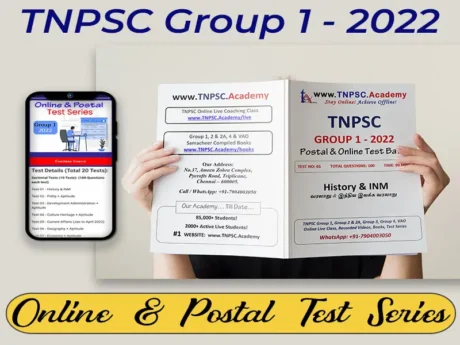
Group 1 | Postal and Online Test Series | 2022
Original price was: ₹3,200.00.₹2,800.00Current price is: ₹2,800.00. 88Class Tests
PRIVATE 67
TNPSC Group 1 - Test Series - 2019
Original price was: ₹3,500.00.₹2,800.00Current price is: ₹2,800.00. 542





Group 2 & 2A Courses
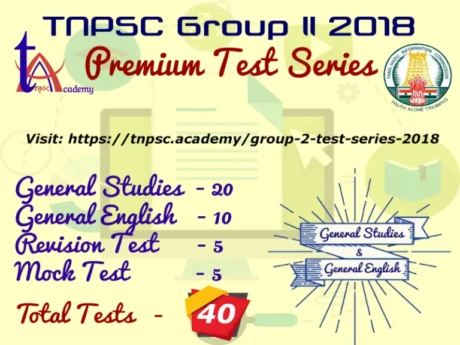
TNPSC Group 2 and 2A - Test Series - 2019
Original price was: ₹2,400.00.₹1,800.00Current price is: ₹1,800.00. 527TNPSC Group 2 and 2A - Test Series - 2019 - தமிழ்
Original price was: ₹2,400.00.₹1,800.00Current price is: ₹1,800.00. 175TNPSC Group 2 and 2A MAINS - 2022
PRIVATE 344Class Tests
PRIVATE 67




www.tnpsc.academy – TNPSC Current Affairs January 15, 2020 (15/01/2020)
Download as PDF
Topic: General Administration, Profile of States
Classical language
At the recently concluded 93rd edition of the Akhil Bharatiya Marathi Sahitya Sammelan, a resolution was passed demanding the declaration of Marathi as a ‘Classical’ language.
What are ‘Classical’ languages in India?
Currently, six languages enjoy the ‘Classical’ status: Tamil (declared in 2004), Sanskrit (2005), Kannada (2008), Telugu (2008), Malayalam (2013), and Odia (2014).
Guidelines for declaring a language as ‘Classical’ are:
High antiquity of its early texts/recorded history over a period of 1500-2000 years.
A body of ancient literature/texts, which is considered a valuable heritage by generations of speakers.
The literary tradition be original and not borrowed from another speech community.
The classical language and literature being distinct from modern, there may also be a discontinuity between the classical language and its later forms or its offshoots.
_
Topic: Latest inventions on Science and Health
Bharati Script
Researchers from IIT Madras have already developed a unified script for nine Indian languages, named the Bharati Script.
Now, going a step further, developed a method for reading documents in Bharati script using a multi-lingual optical character recognition (OCR) scheme.
What is Optical Character Recognition (OCR) scheme?
It involves first separating (or segmenting) the document into text and non-text. The text is then segmented into paragraphs, sentences words and letters. Each letter has to be recognised as a character in some recognisable format such as ASCII or Unicode. The letter has various components such as the basic consonant, consonant modifiers, vowels etc.
What is Bharati Script?
It is an alternative script for the languages of India developed by a team at the Indian Institute of Technology (IIT) in Madras lead by Dr. Srinivasa Chakravarthy.
The scripts that have been integrated include Devnagari, Bengali, Gurmukhi, Gujarati, Oriya, Telugu, Kannada, Malayalam and Tamil.
_
Topic: Latest Diary of Events, Mass Communication
Juice jacking
SBI has publicly issued a warning of ‘Juice Jacking’ through its twitter handle.
The bank has advised its customers and general public to “think twice before plugging-in their phone at (pubic) charging stations, as hackers can maliciously infect their smartphone with a malware.”
What is Juice Jacking?
It is an attack carried out by hackers through a USB charging cable.
How it works?
When a user plugs in the charging cable in his mobile’s charging port, and connects it to any of the rigged charging stations installed at public spaces such as airports, train stations, hotels, cafes etc – it gives a back-door entry to hackers into the compromised device.
The charging port which is also used for data transfer over the USB, is pointed as the main cause of concern over here.
Threats:
Installing malware, cleaning user data, asking ransom in exchange for access to personal data on the phone, personal and financial account hijacking are just some of the many nefarious things that a hacker can do with this unrestricted access.
Steps to Mitigate the Risks:
In order to guard your phone against Juice Jacking, take these precautionary measures:
Avoid using public charging stations. These are soft targets for hackers as they are often kept unguarded and without any surveillance.
Always use your own AC charging adapter and cable for charging the device. And be sure to plug it into the AC wall socket, and not the USB socket on the wall.
Stay guarded against a stranger’s device and laptop. Do not connect with an unknown person’s laptop or PC for charging your electronic devices and vice-versa.
For emergency situations, buy and carry a certified power bank with enough capacity to take care of your device’s emergency power backup needs.
Try to use a cable that can be used only as a charging cable and not a data cable.
Frequent travelers should use a USB blocker.
_
Topic: Latest inventions on Science and Health
‘Virtual human’ NEONs
The first project of Samsung’s Star Labs, NEONs are being called the world’s first artificial humans.
What are they?
NEONs are computationally created virtual humans — the word derives from NEO (new) + humaN.
For now the virtual humans can show emotions when manually controlled by their creators. But the idea is for NEONs to become intelligent enough to be fully autonomous, showing emotions, learning skills, creating memories, and being intelligent on their own.
How do they work?
There are two core technologies behind his virtual humans. First, there is the proprietary CORE R3 technology that drives the “reality, real time and responsiveness” behind NEONs.
The next stage will be SPECTRA, which will complement CORE R3 with the “spectrum of intelligence, learning, emotions and memory”.
How could NEONs be used?
NEONs might be the interface for technologies and services.
They will answer your queries at a bank, welcome you at a restaurant, or read out the breaking news on television at an unearthly hour.
This form of virtual assistance would be more effective, for example, while teaching languages, as NEONs will be capable of understanding and sympathising.
_
Topic: Places in News
Taal volcano
It is a volcano on the island of Luzon in Philippines erupted recently.
It is classified as a “complex” volcano. A complex volcano, also called a compound volcano, is defined as one that consists of a complex of two or more vents, or a volcano that has an associated volcanic dome, either in its crater or on its flanks.