
TNPSC Books
-
 TNPSC General English Book - for Group 2 & 2A
Original price was: ₹1,000.00.₹850.00Current price is: ₹850.00.
-
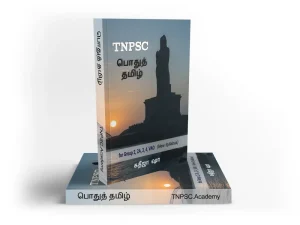
TNPSC பொதுத் தமிழ் Book - for Group 2, 2A, 3, 4 & VAO
Original price was: ₹1,000.00.₹850.00Current price is: ₹850.00.

Group 1 Courses

TNPSC Group 1 - Test Series - 2019
Original price was: ₹3,500.00.₹2,800.00Current price is: ₹2,800.00. 542
Class Tests
PRIVATE 67Group 1 | Postal and Online Test Series | 2022
Original price was: ₹3,200.00.₹2,800.00Current price is: ₹2,800.00. 88






Group 2 & 2A Courses
Class Tests
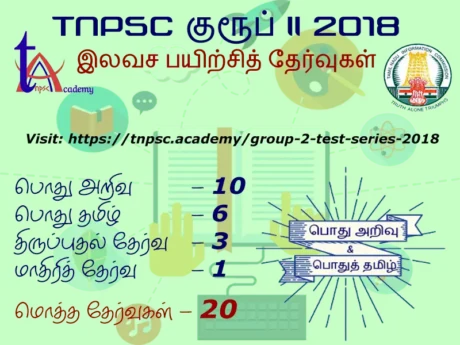
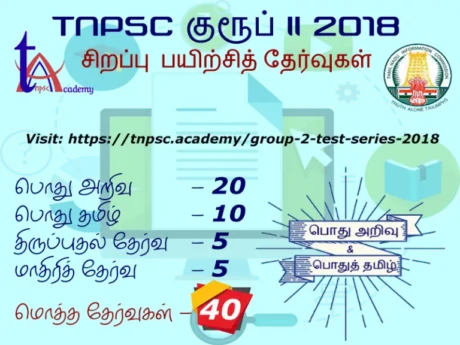
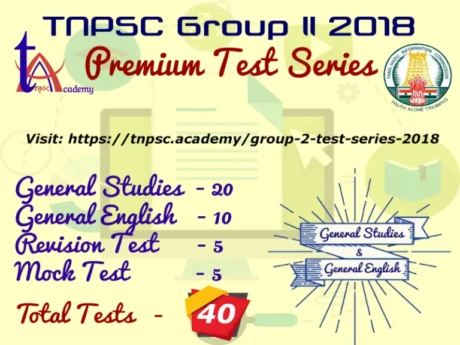
PRIVATE 67TNPSC Group 2 and 2A - Test Series - 2019
Original price was: ₹2,400.00.₹1,800.00Current price is: ₹1,800.00. 527TNPSC Group 2 and 2A - Test Series - 2019 - தமிழ்
Original price was: ₹2,400.00.₹1,800.00Current price is: ₹1,800.00. 175TNPSC Group 2 and 2A MAINS - 2022
PRIVATE 344




www.tnpsc.academy – TNPSC Current Affairs June 22, 2020 (22/06/2020)
Download as PDF
Topic: Public Awareness and General Administration, Profile of States
Garib Kalyan Rojgar Abhiyaan
Prime Minister Narendra Modi launched the mega ‘Garib Kalyan Rojgar Abhiyaan’ aimed to boost livelihood opportunities in rural India amid the ongoing Covid-19 crisis.
Highlights of the scheme:
The first priority of the scheme is to meet the immediate requirement of workers who have gone back to their districts by providing them with livelihood opportunities.
The focus is also on rural citizens.
It is a focused campaign of 125 days across 116 districts in six states to work in mission mode.
Public works worth 50,000 crore rupees to be carried out under the scheme.
It includes focused implementation of 25 different types of work to provide employment and to create durable infrastructure.
The villages will join this programme through the common service centres and Krishi Vigyan Kendras.
Implementation of the scheme:
The scheme will be a coordinated effort by 12 different ministries including rural development, Panchayati Raj, Road transport and highways, mines, drinking water and sanitation, environment, railways, petroleum and natural gas, new and renewable energy, border Roads, Telecom and agriculture.
_
Topic: Latest inventions on Science and Health
Intercropping
Kerala government is planning to modify specific laws that govern the plantation sector to allow the management to intercrop food crops with cash crops such as tea, coffee, cardamom and rubber.
Laws that need modification include the Kerala Land Reforms Act, Kerala Grants and Leases (Modification of Rights) Act and Kerala Land Utilisation Order.
Need for:
To break its dependency on food imports from neighbouring States.
To guard against possible food protectionism by large-scale producers by opening up plantations for farming edibles.
Proposed plan:
The Kerala Agriculture University had zoned Kerala into 23 agro-climatic sectors.
It had suggested that oranges, apples, avocados, grapefruit and winter vegetables as ideal intercrop for high altitude tea plantations in regions such as Munnar.
In rubber growing regions, the cultivation of rambutan, mangosteen and other tropical fruits in small plots interspersed among the trees has been suggested.
It had also suggested jack fruit as shade trees in tea, coffee and cardamom plantations.
What is intercropping?
It is the cultivation of two or more crops simultaneously on the same field.
The main goal is to produce a greater yield on a given piece of land by making use of resources of ecological processes that would otherwise not be utilised by a single crop.
There are different approaches to intercropping such as:
Mixed intercropping – two or more crops are planted in a mix without a distinct row arrangement.
Row intercropping – two or more crops are planted in distinct rows.
Relay intercropping – two or more crops are grown at the same time as part of the life cycle of each i.e. a second crop is sown after the first crop has been well established but before it reaches its harvesting stage.
Strip intercropping – growing two or more crops at the same time in separate strips wide enough apart for independent cultivation.
Advantages of intercropping:
More efficient use of light, water and other nutrient resources compared to single crops.
It allows for effective management of cover crops because crop mixtures have lower pest densities.
Potential increased crop yields per unit area.
Improved soil fertility by leguminous intercrops e.g. nitrogen fixing.
Reduced soil erosion.
Lowered soil surface evaporation.
_
Topic: Current Socio-Economic Issues
Covifor
It is an antiviral Remdesivir for treatment of COVID 19. Drug Controller General of India has recently given its nod to Drugmaker Hetero to launch this new drug.
It is the second such drug to enter the Indian market after Fabiflu by Glenmark, which came a day earlier.
_
Topic: Discovery of Rare Species, Latest Diary of Events
Golden Langurs
Primatologists have observed that the Gee’s golden langur induce stillbirth of babies killed inside the womb of females, besides practising infanticide.
Forced abortion and infanticide happen when a new male takes over. He often kills the baby of a lactating female or hits the abdomen of a female impregnated by the deposed male till the point of abortion.
Key facts:
Obstructions such as wires, and gaps in the forest due to felling, have increased the threat of inbreeding among golden langurs.
In 2019, Bhutan recorded a drop of 62% in the population of golden langurs over the 2009 census. The recorded estimation in Assam in 2009 was 5,140. This year’s census could not be completed due to the COVID-19 lockdown.
_
Topic: Latest Diary of Events
International Yoga Day – June 21
Observed on June 21st every year. Theme for 2020: “Yoga for Health – Yoga at Home”.
The World Health Organization mentions yoga as a means to improve health in its Global Action Plan on Physical Activity 2018–2030: More active people for a healthier world.
The UN proclaimed June 21 as International Day of Yoga by passing a resolution on December 11, 2014, during the 69th session of the General Assembly.