
TNPSC Books
-
 TNPSC பொதுத் தமிழ் Book - for Group 2, 2A, 3, 4 & VAO
Original price was: ₹1,000.00.₹850.00Current price is: ₹850.00.
-
TNPSC General English Book - for Group 2 & 2A
Original price was: ₹1,000.00.₹850.00Current price is: ₹850.00.
Group 1 Courses

TNPSC Group 1 - Test Series - 2019
Original price was: ₹3,500.00.₹2,800.00Current price is: ₹2,800.00. 542
Class Tests
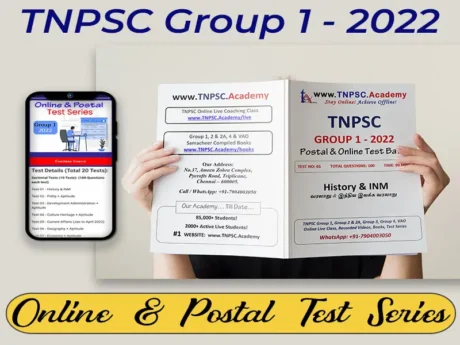
PRIVATE 67Group 1 | Postal and Online Test Series | 2022
Original price was: ₹3,200.00.₹2,800.00Current price is: ₹2,800.00. 88




Group 2 & 2A Courses
TNPSC Group 2 and 2A - Test Series - 2019
Original price was: ₹2,400.00.₹1,800.00Current price is: ₹1,800.00. 527TNPSC Group 2 and 2A MAINS - 2022
PRIVATE 344Class Tests
PRIVATE 67TNPSC Group 2 and 2A - Test Series - 2019 - தமிழ்
Original price was: ₹2,400.00.₹1,800.00Current price is: ₹1,800.00. 175





www.tnpsc.academy – TNPSC Current Affairs April 01, 2020 (01/04/2020)
Download as PDF
Topic: Profile of States, General Administration
Punjab Village and Small Towns Act
This British-era law was recently invoked in Panchkula to curtail movement during lockdown.
Deputy Commissioner of Panchkula has passed an order under section 3 of this Act and has declared that all able-bodied male inhabitants of the villages be liable to be on patrol duty both during the day and night.
The aim of the patrol in the present case is to keep a watch on people entering villages without a valid pass and to make sure villagers follow social distancing norms.
What is the law?
The law was first enacted in 1918 in erstwhile Punjab to make provisions for nightly patrol duty by inhabitants of small villages and towns in cases of emergency.
Penalty and punishment:
Those who do not follow the provisions will be liable under sections 9 and 11 of the Act, which means they may have to pay a fine imposed by the village panchayat or a fine imposed by the deputy commissioner, not exceeding Rs 100.
_
Topic: Inventions of new technology in Science and Health
SunRISE mission
NASA has selected a new mission to study how the Sun generates and releases giant space weather storms – known as solar particle storms – into planetary space.
Overview of the mission- the Sun Radio Interferometer Space Experiment (SunRISE):
It is an array of six CubeSats operating as one very large radio telescope. NASA has awarded $62.6 million to design, build and launch SunRISE by no earlier than July 1, 2023.
Objectives of the mission:
To study how the Sun creates and releases giant solar particle storms. To help scientists understand the workings of the Solar System.
How it works?
The mission design relies on six solar-powered CubeSats to simultaneously observe radio images of low-frequency emission from solar activity and share them via NASA’s Deep Space Network.
The constellation of CubeSats would fly within 6 miles of each other, above Earth’s atmosphere, which otherwise blocks the radio signals SunRISE will observe.
Together, the six CubeSats will create 3D maps to pinpoint where giant particle bursts originate on the Sun and how they evolve as they expand outward into space.
This, in turn, will help determine what initiates and accelerates these giant jets of radiation.
The six individual spacecraft will also work together to map, for the first time, the pattern of magnetic field lines reaching from the Sun out into interplanetary space.
Why study solar particle storms?
This information will help improve understanding of how our solar system works. It can help protect astronauts traveling to the Moon and Mars by providing better information on how the Sun’s radiation affects the space environment they must travel through.
Background:
NASA had chosen two missions in August 2017 for its Mission of Opportunity program, a part of its Explorers Program, to conduct an 11-month concept study. The SunRise mission was one of the two missions.
_
Topic: International Events, Latest inventions on Science and Health
Bear bile
For treating severe and critical cases of COVID-19, Chinese government has recommended an injection of Tan Re Qing, which contains bear bile.
The use of bear bile in Chinese medicine dates back at least 1,300 years. Bile is secreted by the liver and stored in the gall bladder.
Bile from bears tends to be high in ursodeoxycholic acid, also known as ursodiol, which is helpful in dissolving gallstones and treating liver disease.
_
Topic: Science and Technology, Latest Diary of Events
Sodium hypochlorite
Sodium hypochlorite is commonly used as a bleaching agent, and also to sanitise swimming pools. It releases chlorine, which is a disinfectant. Large quantities of chlorine can be harmful.
At a much lower 0.25-0.5%, this chemical is used to treat skin wounds like cuts or scrapes. An even weaker solution (0.05%) is sometimes used as a handwash.
It is corrosive and is meant largely to clean hard surfaces. It is not recommended to be used on human beings.
A 1% solution can cause damage to the skin of anyone who comes in contact with it. If it gets inside the body, it can cause serious harm to lungs.
Why in News? In Uttar Pradesh, migrant workers travelling to their home states, or their belongings, were sprayed with a disinfectant containing sodium hypochlorite, apparently to sanitise them.
_
Topic: International Diary of Events
UN Security Council adopts Resolution on Safety and Security of Peace Keepers
The United Nations Security Council adopted Resolution 2518 to ensure safety and security of peacekeepers. This is the first time, a resolution is being passed for the safety of the peacekeepers.
Key facts:
The resolution was initiated and sponsored by China. It was co-sponsored by 43 countries including Pakistan, Iran, South Africa, Turkey, Russia, Vietnam, etc.
Today there are more than 95,000 peacekeepers operating in around 13 missions all over the world.
There solution of safety of peacekeepers comes in a time when the United Nations is marking 75th anniversary. This is a crucial year for the organization to implement “Action for Peace”.
Action for Peace:
The Action for Peace initiative was launched by the United Nations to help countries address challenges such as elusive political issues, protracted conflicts, dangerous environments, broad and complex mandates, etc. The initiative will focus on targeted mandates, support political solutions.